
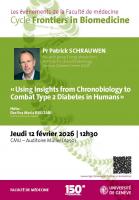
«Using insights from chronobiology to combat type 2 diabetes in humans»
12.02.2026 12:30 – 13:30
Recently our 24-hour culture has been identified as another lifestyle factor that can cause type 2 diabetes. Technological and societal advances such as electric lighting and digital screens – leading to light exposure that is too dim during the day and too bright during the evening –, shift work, time zone transfers, and round-the-clock food availability disrupt our intrinsic and evolutionarily preserved 24-hour rhythms resulting in a desynchronization between light cues and behavior cues to our circadian system. This mistiming of cues is now thought to be a large contributor to the current metabolic health crisis, a concept known as circadian misalignment. Our internal biological clock sets circadian rhythmicity of a large range in bodily functions, including energy metabolism. We have shown that whole body energy expenditure and skeletal muscle mitochondrial function displays 24h rhythmicity in humans, a rhythm that is disturbed in prediabetic volunteers. Furthermore, under healthy conditions, our 24h energy metabolism is aligned to periods of feeding and fasting, and this fed-fasted cycle is disturbed in type 2 diabetes. We have also shown that a rapid day-night shift can lead to insulin resistance in healthy humans. More recently, using metabolomics analysis performed in human muscle material, we showed that 24h rhythmicity in muscle energy metabolites derived from healthy versus prediabetes volunteers shows temporal changes most prominent during the night period.
Next to light, also food and activity can function as zeitgebers for the molecular clock. Therefore, timing of interventions can be used to improve metabolic health; we and others showed that exercise training in the afternoon may have more beneficial effects compared to exercise training in the morning. Also, time restricted feeding improves rhythmicity of our metabolism and glucose homeostasis, and recent findings suggests that also light exposure can influence our 24h energy metabolism.
Lieu
Bâtiment: CMU
Auditoire Müller
Organisé par
Décanat Faculté de médecineIntervenant-e-s
Pr Patrick SCHRAUWEN, Research group Energy Metabolism, Institute for Clinical Diabetology, German Diabetes Center (DDZ)entrée libre
Fichiers joints
 | afficheA3_FIB_Schrauwen2.pdf | 176 Kb |
 haut
haut